
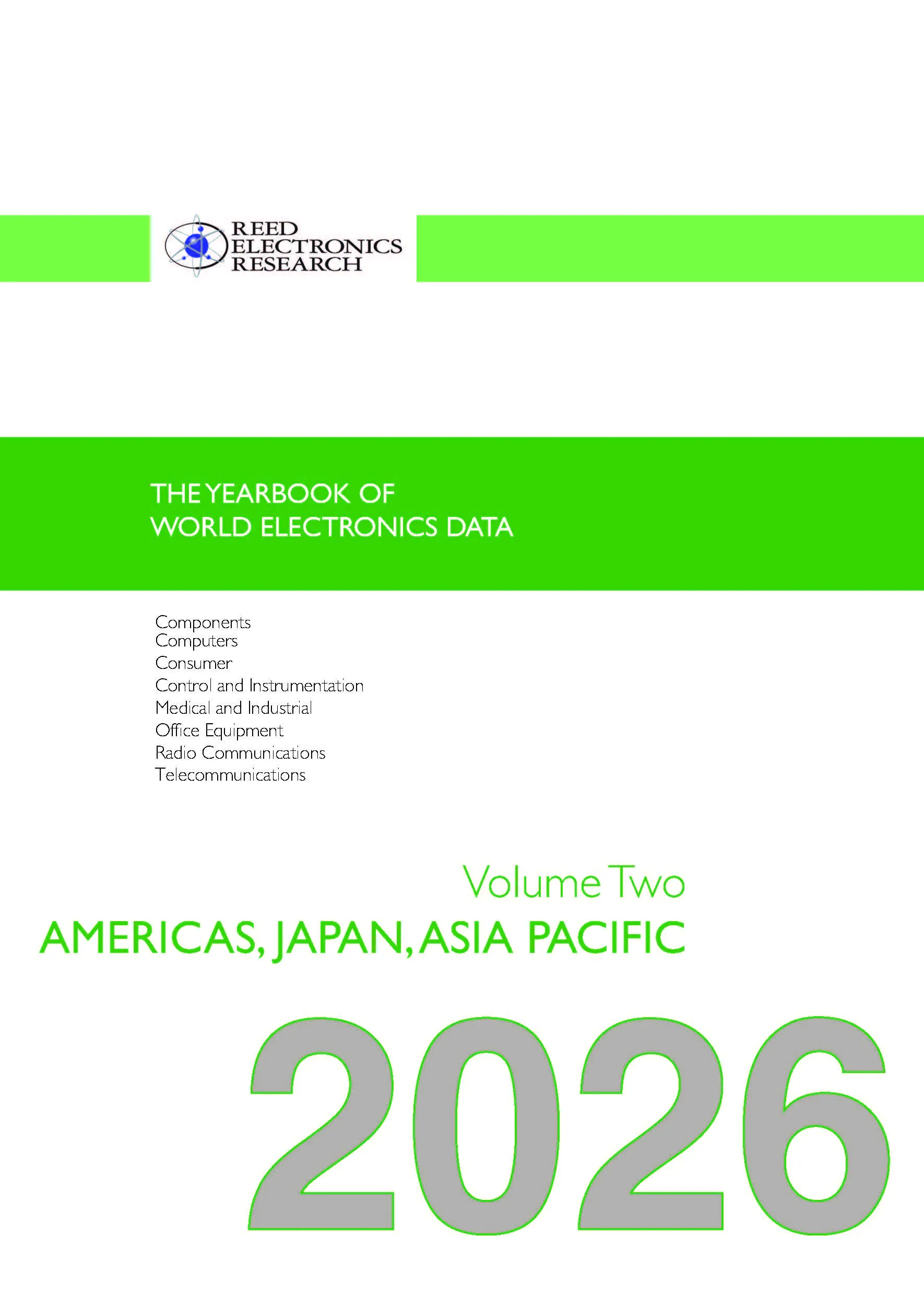
Yearbook of World Electronics Data - Volume 2 2026 - Americas, Japan, Asia Pacific
In providing the forecasts for the current study, which were made at the end of October 2026, we have:
- An escalation of the US and Israeli war on Iran could leading to higher energy prices, further supply chain disruptions and lower investment and consumer spending on the back of weaker growth globally.
- The huge investments in AI and data centres is leading to severe supply constraints for memory chips and dramatically increasing prices. The current memory crunch is expected to continue into 2027 and potentially 2028.
- With higher memory costs pushing the cost of smartphones, PCs and other consumer electronics equipment higher it is expected that demand will weaken over the course of 2026 and into 2027. Manufacturers are also expected to focus on premium brand products.
- AI demand and raw material shortages are also impacting the supply of PCBs and other passive components including capacitors leading to higher prices and the potential of allocation.
- The current shortage of materials and components could lead to a spike in revenues as costs are passed through and lead to similar market conditions to 2022 and 2023.
- AI and data centre consumption will be a key driver of growth in the overall computer market in the period to 2028/2029.
Despite the potential headwinds we expect growth in the electronics industry to strengthen over the course of 2026 and gain momentum in 2027 and 2028 with growth expected to ease in the final year of the forecast. However, the shortage of components and materials could see production and deliveries pushed into 2027.
Americas
In 2025, electronics production in North America amounted to US$424 billion with the US dominating accounting for 72.8% of the total. Mexico, which acts as the low-cost production base for the region, 24.2% while Canada accounted for only 3.0%. After increasing in US dollars by 4.3% in 2024, growth increased by 14.0% in 2025 with growth forecast to surge to 24.7% in 2026.
In Canada the growth in electronics output after increasing by 4.3% in 2023, eased to 1.2% in 2024 before rebounding with growth of 4.3% and 5.8% in 2025 and 2026, respectively. Communications and radar and control and instrumentation represented the largest segments accounting for 35.4% and 36.6% of electronics output in 2025, respectively in 2025. The component segment is small, accounting for only 7.5% of output in 2025.
Mexico will continue to benefit from foreign investment as both OEMs and EMS/ODMs look to utilise low-costs sites in the country as a production base to serve the North American market. The focus will remain on electronics equipment with limited investment expected in expanding the country’s electronic components ecosystem.
After growth of 3.9% in 2023 the US production of electronics equipment eased to 1.5% in 2024, increased by 3.8% in 2025 and is forecast to accelerate to 8.8% in 2026. In the same period electronic component output is forecast to increase by 11.9%, 10.3% and 19.5%, growth in 2026 boosted by higher prices.
Japan
After increasing by 5.6% in 2024 Japanese electronics output eased to 3.1% in 2025 but is forecast to post growth of 33.7% in 2026. Growth in 2026 will be driven by a 55.2% increase in electronic component output. Based on official figures for the first seven months of 2026 the production of ICs is forecast to increase by 175.0% through a combination of rapidly rising demand from the AI and data centre markets and higher pricing. The production of passive components increased by 2.9% in 2024, 6.8% in 2025 and a forecasted 12.6%. Growth in 2025 and 2026 will be driven by rising demand for capacitors, resistors, connectors and in particular PCBs.
Electronics equipment, which accounted for 44.7% of the total in 2025, increased by 2.1% with output forecast to increase by 6.8% in 2026. Growth in 2026 will be supported by a 25.0% increase in communications and radar and growth of 8.0% in telecommunications equipment
Asia
In 2025, the production of electronics equipment and components in Asia was valued at US$1,658 billion of which electronics equipment production accounted for 55.5% of the total with output dominated by computing and communications. Asia is also the centre for electronic componet output globally.
China dominates electronics production in the region with total electronics output valued at US$801 billion in 2025. Taiwan and South Korea, with their strong focus on semiconductors, both reported electronics production of US$226 billion and US$198 billion, respectively while Singapore with output of US$110 billion and Malaysia US$94 billion also benefited from an established semiconductor industry. Vietnam, which due to its low-costs has seen explosive growth in recent years, is a major centre for the production of mobile phones and more cently computing reported electronics output of US$95 billion in 2025. Electronics production in India was valued at US$55 billion in 2025 growth being supported by government incentives as the country looks to establish itself as a major global manufacturing hub.
13 major product groups
Market Data 2023-2029
Production Data 2023-2026
Electronic-option allows you to manipulate the data quickly and easily: produce your own subsets or summaries of the data, create your own forecasts or cut and paste the data into your own in-house reports and presentations.
19 countries covered:
Australia
Brazil
Canada
China
Hong Kong
India
Indonesia
Israel
Japan
Malaysia
Mexico
Philippines
Singapore
South Africa
South Korea
Taiwan
Thailand
USA
Vietnam
Yearbook of World Electronics Data Volume 2 2026 - Contents and Sample Pages.pdf (file opens in new window)
First Published 1983
ISBN 1 905429 983
Publication Date: November 2026
Pricing
Yearbook of World Electronics Data Volume 2 2026
Report only
£1,295.00
Yearbook of World Electronics Data Volume 2 2026
Report + CD ROM
£1,595.00
Yearbook of World Electronics Data Volume 2 2026
Corporate Licence
£2,590.00
The Corporate License allows electronic distribution (excluding distribution to third parties) of the report throughout your organisation, making it a cost effective and essential tool for your business